Nandhu Krishnan A

Intern at Bosch Global Software Technologies in Coimbatore, until March 2027

NandhuKrishnan A

I build LLM systems, vision models and accessible AI, from medical diagnostics to safety guardrails for production chatbots.

See selected workContact me

About

I'm an applied AI engineer and CS student at CUSAT, interning at Bosch Global Software Technologies in Coimbatore. I've worked on LLM safety for a medical chatbot, a vision system that grades handwritten papers, and low-cost non-invasive diagnostics. Outside the lab I host AI Wednesday and mentor hackathons across Kerala.

Right now

Intern at Bosch Global Software Technologies in Coimbatore, until March 2027

100+countries running Zorgm.ai
645papers graded in 16 minutes by AutoEval
9.31CGPA at CUSAT
GATE 2026qualified, Data Science and AI

Based in

Kerala, India

Experience

Internships and research, newest first. The dark panels are concept illustrations.

Jul 2026 – Mar 2027

Bosch Global Software Technologies

Intern, Coimbatore

  • Nine-month internship at BGSW's Coimbatore campus, running until 31 March 2027.
  • Details of the work are kept private for now.
SW

Aug 2025 – Mar 2026

Laennec AI (Zorgm.ai)

AI Engineer (AI Intern)

  • Contributed to the AI layer of Zorgm.ai on Gemini / Google Vertex AI, deployed across 100+ countries.
  • Multi-layer LLM safety: Google Model Armor, prompt-injection detection, response validation.
  • RAG + web search pipelines to cut hallucinations in multilingual medical answers.
injection?

May – Jul 2025

IIT Kharagpur, CRTDH

Research Intern

  • Non-invasive hemoglobin, glucose and bilirubin sensing with NIR spectroscopy (AS7265x + 940nm LEDs, Arduino Nano).
  • XGBoost and Random Forest models on a custom spectral dataset for low-cost rural diagnostics.
visibleNIR

Nov 2024 – Feb 2025

Typito

Software Engineering Intern

  • Led development of an AI feature that turns G2 reviews into video content and set up the project foundation.

May – Dec 2024

NoTime

Software Engineer & Mentor

  • Built software at an education-focused startup and mentored students in full-stack and AI.

May – Jun 2024

IIST, Thiruvananthapuram

Summer Research Intern

  • Built AutoEval for the NCVPRIPG'24 challenge: top-5 finish, presented at the conference.
  • 645 handwritten papers evaluated in 16 minutes on an RTX 3050.
T✓F✕T✓T✓F✕T✓T✓

May – Jun 2023

Segmind

Software Engineering Intern

  • Built a Midjourney-style Discord bot for on-demand image generation across multiple Segmind models.
/imagine a fox

Selected work

Research, production and side projects. The dark panels are concept illustrations unless the caption says otherwise.

LLM safety, in production

Zorgm.ai

Multilingual medical chatbot platform on Gemini / Vertex AI. My part: guardrails, prompt-injection detection and RAG + web-search prompting to keep answers grounded.

Employer product (Laennec AI), so no public repo.

  • Gemini
  • Vertex AI
  • Model Armor
  • RAG
PromptModel ArmorRAG + webGeminiValidate✕ injection blocked

Computer vision, top 5 at NCVPRIPG'24

AutoEval

Evaluates handwritten True/False answer sheets: Table Transformer finds the table, a TinyVGG classifier reads each cell, and a Flask endpoint returns the marks.

  • PyTorch
  • Table Transformer
  • TinyVGG
  • Flask

Code

True✓False✕True✓True✓False✕True✓

Signal processing, Semester 8 project

Explainable audio classification

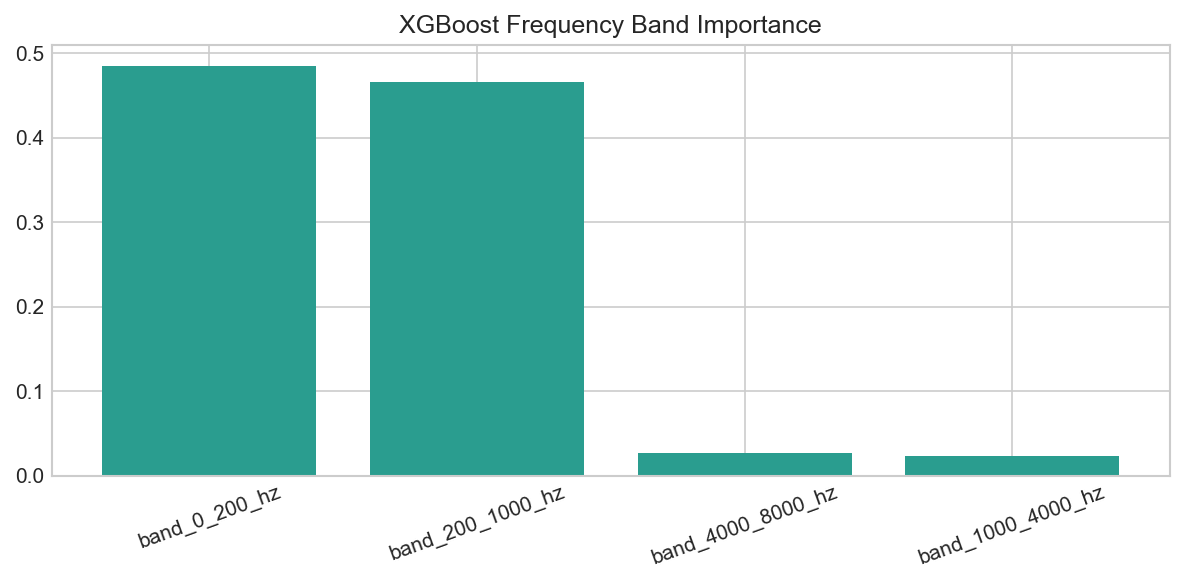
Classifies five urban sound classes from UrbanSound8K (gun shot, jackhammer, engine idling, drilling, siren) using FFT, band-energy and MFCC features. Feature importance picks out the frequency bands that drive each prediction, then bandpass filtering and an inverse FFT map them back onto the waveform. XGBoost scored best at 83.3%.

Code isn't public yet.

  • Python
  • librosa
  • FFT
  • XGBoost
  • scikit-learn
  • UrbanSound8K
Bar chart of XGBoost frequency band importance from the project report: 0 to 200 Hz and 200 to 1000 Hz bands dominate
Figure from the project report.

Hardware and ML, IIT Kharagpur

Non-invasive blood diagnostics

A portable NIR-spectroscopy prototype that estimates hemoglobin, glucose and bilirubin, using XGBoost and Random Forest on a custom spectral dataset.

Research work; not published as a repo.

  • AS7265x
  • Arduino Nano
  • XGBoost
  • Random Forest
HbGlucoseBilirubin

GraphRAG prototype

Diagnose-Me

Medical assistant that combines a Neo4j knowledge graph with FAISS retrieval and Gemini, with a doctor-review step before anything is approved. A research prototype, not a clinical tool.

  • Neo4j
  • FAISS
  • Gemini
  • Flask
  • Next.js
  • MongoDB

CodeLive demo

entitiesquery path

Generative vision, semester project

Light-Level cGAN

A PyTorch conditional GAN (encoder-decoder generator with skip connections) that shifts image lighting by a continuous condition from −1 to +1. A second repo uses its output to augment ResNet50, EfficientNet and ViT classifiers on the Intel Image dataset.

  • PyTorch
  • cGAN
  • LOL-v2
  • ResNet50
  • EfficientNet
  • ViT

cGANAugmentation experiments

condition +0.30

Generative AI

Lumina

Text-to-image app with Stable Diffusion, prompt enhancement through GPT-4 or Gemini, and live progress over WebSocket. FastAPI backend, Next.js frontend.

  • Stable Diffusion
  • FastAPI
  • Next.js
  • WebSocket

Code

prompt › a lighthouse at dusk, oil painting

AI agent tooling, early stage

secure-vibe-coding

Security skills for AI coding agents: rule packs, a stdlib-only Python scanner and Claude Code hooks that scan what the agent writes. Defense in depth, not a guarantee.

  • Python
  • Agent Skills
  • Claude Code hooks
  • Evals

Code

agent wrote: app/db.py
1def connect(user):
2 key = "sk-live-xxxxxxxx"
3 q = f"SELECT * WHERE id={user}"
4 return run(q)
secscan: 2 findings→agent fixes, rescans: clean

Accessibility, hackathon 2nd prize

Inclusify

Team-built accessibility platform for specially-abled users: voice navigation, sign-language recognition, a RAG-based YouTube summarizer, personalized MCQs, PPT-to-video and YouTube Braille support.

  • RAG
  • Sign-language recognition
  • Voice UI

Code

Voice navigation
Sign recognition
Braille support
Video summaries

More repositories

Explainable audio, step by step

How the Semester 8 project turns a classifier's decision into something you can see. The signal drawn here is synthetic and frequencies are not to scale; the real figures are in the project report.

  1. Step 1 of 5

    Start with the sound

    A short urban-sound clip: engine idling, drilling, jackhammer, siren or gun shot from UrbanSound8K. The waveform shows loudness over time, and little else.

  2. Step 2 of 5

    Move to frequencies

    A Fourier transform turns the clip into frequency content, alongside band energies and MFCC statistics. These are the features the classifiers learn from.

  3. Step 3 of 5

    Ask which bands mattered

    XGBoost's feature importance ranks the frequency bands behind its predictions. In the report's chart, the two lowest bands carry almost all of the weight.

  4. Step 4 of 5

    Filter them back out

    A bandpass filter keeps only those bands, and an inverse Fourier transform turns them back into a waveform you can look at.

  5. Step 5 of 5

    Mark where it listened

    Laid over the original clip, the stretches where that filtered signal is strongest show which moments the model leaned on.

Band weights are redrawn from the report's Fig. 4.3 and are approximate.

Toolkit

What I reach for most often.

AI / ML
  • PyTorch
  • TensorFlow
  • Keras
  • Hugging Face
  • Stable Diffusion
  • Scikit-Learn
  • OpenCV
LLM systems & safety
  • RAG
  • FAISS
  • LangChain
  • GraphRAG
  • Gemini on Vertex AI
  • Google Model Armor
  • Prompt engineering
Backend & tools
  • FastAPI
  • Flask
  • Node.js
  • Docker
  • Git
Frontend
  • React
  • Next.js
  • Tailwind CSS
Databases
  • MongoDB
  • Neo4j
Languages
  • Python
  • C++
  • Java
  • JavaScript
  • TypeScript
  • SQL

Community and teaching

Hackathons, weekly AI sessions and student workshops around Kerala.

2026

Tink-her-hack 4.0

Host, mentor and judge

Part of the organizing team for Kerala's largest women-only hackathon, with 6,000 participants.

2025 – 26

IRES SEDS CUSAT

Tech Head

Led the technical team for space-education initiatives.

Feb 2025

Tink-her-hack 3.0

Host, mentor and judge

Women-only hackathon with 4,000 participants at SNGCE Ernakulam and Adoor Engineering College. Also taught an HTML/CSS/JS class beforehand.

Jan 2025

Starlet 3.0

Mentor

Mentored teams at a women-only hackathon.

2023 – 25

TinkerHub

Community Manager & CUSAT Lead

Ran community engagement, events and tech initiatives for the CUSAT chapter.

Sessions I've taught

  • Git & GitHub Zero-to-Hero
  • Vibe Coding with Copilot & Cursor
  • Introduction to AI
  • Space Exploration using AI
  • Intro to ML at IEEE Techsortium'25
  • HTML, CSS & JS for women makers

Education

Integrated M.Sc. Computer Science, AI & Data Science

Cochin University of Science and Technology. CGPA 9.31.

GATE 2026 (Data Science & AI): Qualified.

Certificates

  • Machine Learning Specialization from DeepLearning.AI and Stanford, on Coursera
  • Foundations of Cybersecurity from Google, on Coursera
  • Overview of Space Science and Technology from the ISRO START Program